Why This Training Exists
There Is No Shortcut to Serving People Well
Every peer-support and leadership role at RHM requires a real pathway of education, practice, and supervision. There is no direct route from good intentions straight to employment — and that is by design, not by accident.
We believe part of what has fractured our communities — inside the church and outside it — is that we have quietly lost a shared, practiced understanding of what it means to love someone well. Love without wisdom becomes rescue. Compassion without boundaries becomes harm. A caring presence without training can leave the very people it hopes to help feeling unseen, unsafe, or unheard.
That is why RHM built the Relational Recovery Peer (RRP) pathway: not as a barrier to service, but as the road that makes service trustworthy. Every position connected to this work — from peer group facilitation to Director of Peers — requires demonstrated competence, ethics training, supervised practice, and organizational authorization before someone carries real responsibility for another person's recovery.
At the same time, our community's need for care and wellness has never been more visible. Addiction, isolation, grief, and reentry after incarceration touch nearly every family and every church we know. RRP exists to meet that need with people who are both compassionate and capable — formed by Scripture, trained in ethics, and accountable to supervision.
Recovery Requires Relationship
People rebuilding their lives after addiction, trauma, or crisis do not heal through programs alone — they heal through people who walk with them, present and trustworthy, over time.
The Church Has a Peer Gap
Congregations are full of people with lived experience who want to help but have never been trained to do it safely, ethically, or well — leaving both the church and the community under-resourced.
Good Intentions Are Not Enough
Caring deeply is not the same as caring skillfully. Without training in boundaries, ethics, and scope, well-meaning peer support can unintentionally harm the very people it hopes to serve.
Course Details
RRP 210 & RRP 220 Schedule and Tuition
Lead instructor for both courses is Dr. Jeffrey W. Gross. Tuition or verified sponsor authorization must be received before the learner begins training. Approved UMOS/CCEP RHM pathways and church/ministry sponsorship may cover a seat.
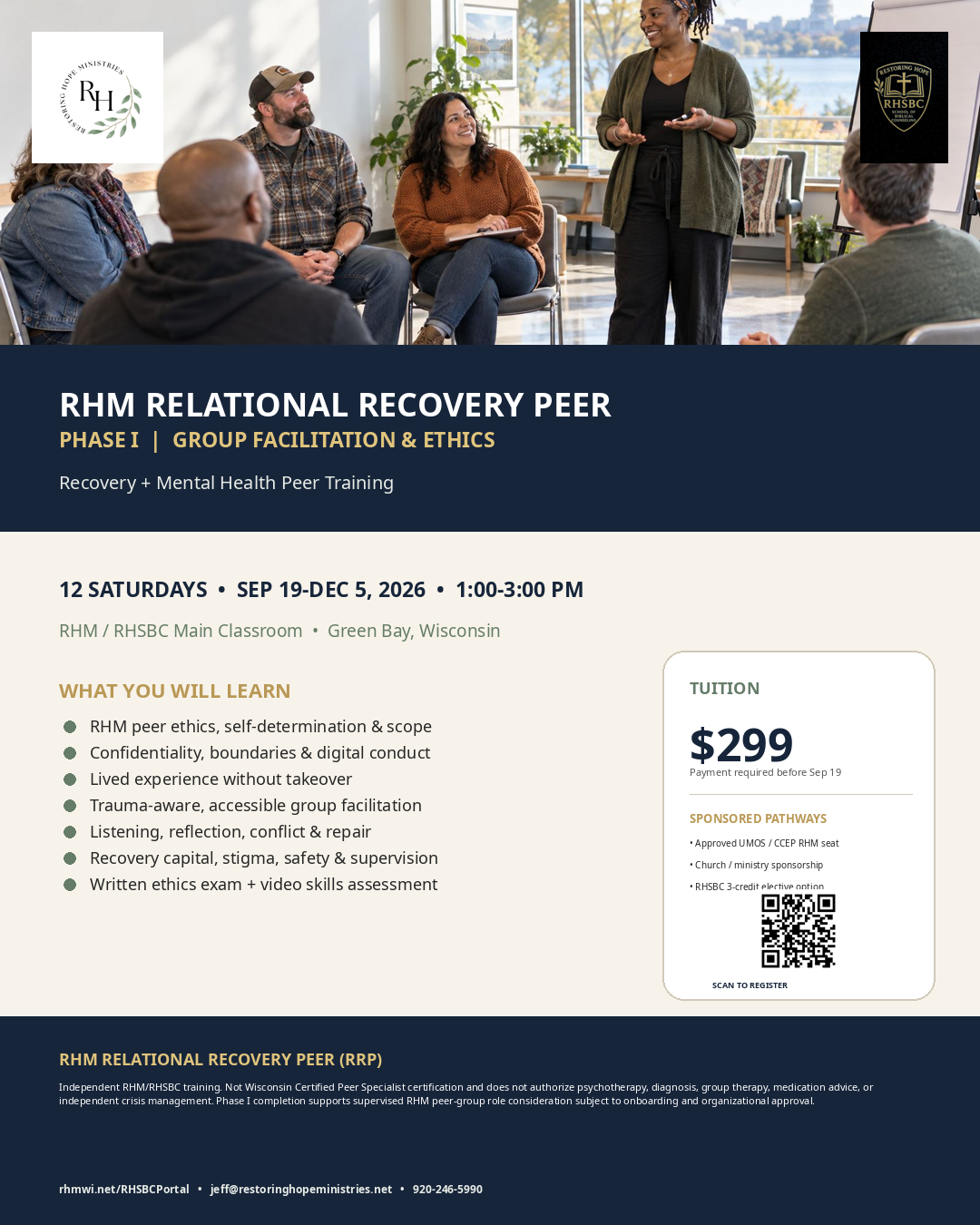
RRP 210 · Fall 2026 · Phase I
Group Facilitation & Ethics
- Saturdays, September 19 – December 5, 2026
- 1:00–3:00 PM Central Time
- 529 S. Jefferson St., Suite 106, Green Bay, WI 54301
- Standard tuition: $299.00
Prerequisite: None — open to adults with relevant lived experience of mental-health and/or substance-use recovery.
RRP 220 · Spring 2027 · Phase II
Individual Peer Support & Recovery Navigation
- Saturdays, January 9 – March 27, 2027
- 1:00–3:00 PM Central Time
- 529 S. Jefferson St., Suite 106, Green Bay, WI 54301
- Standard tuition: $299.00
Prerequisite: Successful completion of RRP 210, or written RHM equivalency approval.
Register or Ask About Sponsorship
Contact Dr. Jeffrey W. Gross to confirm enrollment, sponsorship (church/ministry or approved UMOS/CCEP pathway), and payment.
The Education Pathway
Four Stages, One Purpose: Readiness
Core pathway: Stage 1 → Stage 2 → RRP 290 Capstone → Supervised Practicum → RHM Service Authorization → position-specific employment. Completion of training alone never guarantees a job — leadership sign-off, organizational need, and safeguarding remain separate decisions.
Group Facilitation & Ethics
Fall 2026, 12 Saturdays. Role clarity, the RHM Peer Ethics Covenant, PAUSE ethics pathway, boundaries, confidentiality, trauma-aware communication, purposeful use of lived experience, group facilitation, documentation, and crisis recognition.
Individual Peer Support & Recovery Navigation
Spring 2027, 12 Saturdays. One-to-one peer support, MI-informed listening, recovery capital planning, resource navigation, warm handoffs, crisis/safety escalation, documentation, and faith-responsive support.
Comprehensive Capstone
Written comprehensive exam (85% passing standard), a 25-minute video skills assessment plus oral defense, one guided remediation if needed, and a final RHM readiness review.
Supervised Practicum & RHM Authorization
Placement-specific supervised practice, competency evaluation, safeguarding, and written authorization for assigned RHM duties.
Coming from Out of State? Start Your Education from Afar
You don't need to live in Wisconsin to begin. RHSBC's global online learning platform lets you start your coursework from anywhere in the country and continue the pathway toward peer service and leadership when you arrive.
RHM Internal LMS — Training & Course Access
Our internal learning management system at lms.restoringhopeministries.net hosts the training coursework. Access requires you to be enrolled with a partner school or enrolled directly in our courses — your student credentials are issued upon enrollment.
Where This Training Leads
Built for The 120 House
The RRP pathway is designed as the leadership pipeline for The 120 House — RHM's planned Christ-centered recovery and reentry home for Brown County. Peer graduates will serve as the relational backbone of that community: facilitating groups, providing individual peer support, navigating residents to recovery resources, and — for those who complete the full pathway — leading as Director of Peers.
Peer work at The 120 House is never a substitute for clinical care, chaplaincy, or emergency response. It is a distinct, vital role: trained people who walk alongside residents with humility, truth, and appropriate boundaries — proof that love, practiced well, restores.
Target Launch: 2028
Roles connected to this pathway include Director of Peers, Residential Relational Recovery Peer, Peer Group Facilitator, Recovery Navigation Peer, and Community Reintegration Peer. Starting compensation for the full-time Director of Peers role is approximately $40,000/year after training, competency, and leadership sign-off — within an internal peer-role range up to $75,000/year as experience and responsibility grow.
Five-gate standard: training completion, practicum completion, RHM service authorization, position selection, and any external credential remain separate decisions — training completion alone never guarantees hiring.
Go Deeper
Full RRP Materials on rhmwi.net
Explore the complete training pathway overview, a welcome letter from Dr. Jeffrey Gross, and role details published on our main ministry site.
Week-by-Week
RRP 210 — 12-Week Curriculum
Each Saturday pairs an ethics topic with a skills lab: role-play, listening practice, and case discussion using fictional scenarios only.
Frequently Asked Questions
RRP Training — Common Questions
Answers pulled directly from the official RRP course materials.
What is the role called?
RHM Relational Recovery Peer (RRP). Phase I (RRP 210) prepares supervised peer-group facilitation. Phase II (RRP 220) addresses individual peer support and recovery navigation.
Is this Wisconsin Certified Peer Specialist training?
No. RRP training is independent RHM/RHSBC training informed by Wisconsin DHS and SAMHSA peer competencies. Wisconsin CPS certification requires the separate state-recognized training and examination process.
Can I use this for RHSBC academic credit?
A learner already enrolled at RHSBC may apply RRP 210 or RRP 220 as a three-credit elective when formally registered for the academic track and all additional academic requirements are completed.
How much does it cost?
$299 for the complete Phase I or Phase II training. Payment must be completed before the first session unless an approved sponsoring pathway covers the seat.
What about UMOS or CCEP participants?
Approved RHM participants whose seat is authorized through an eligible UMOS or CCEP funding pathway may have the training sponsored. RHM must confirm funding before the start date.
Can a church pay?
Yes. Churches and ministries may sponsor a specific learner or a scholarship seat. Dr. Jeffrey W. Gross/RHM provides the approved payment or invoice link.
Does completion guarantee a job at the future RHM Recovery Home?
No. It is a training/readiness gate. Actual service depends on the home opening, role availability, onboarding, background requirements, supervision, policy, and RHM approval.
What is the final exam?
RRP 210 learners complete a written ethics/group-practice exam (minimum 80%) and a 15-20 minute video-based peer-group facilitation demonstration using fictional/composite material. RRP 220 adds a capstone (RRP 290): a written comprehensive exam and a 25-minute video skills assessment plus oral defense, each requiring an 85% passing standard.
Peer Leadership Employment Application
Apply for RRP Peer Service or Leadership
For peer and peer-leadership positions connected with The 120 House and RHM recovery transitional housing. Submission does not guarantee employment, schedule, compensation, or placement — final hiring depends on demonstrated competence, completed training, leadership sign-off, and organizational need.

